Driveshaft u-joint sizing for the Audi RS3/TTRS
We have seen some confusing information being shared regarding aftermarket driveshafts for the Audi RS3/TTRS, some claiming a 1200+ hp limit with no caveats or additional information. We have shared torque limits of the key components but also felt it necessary to publish some additional data direct from Spicer. In addition, we are also sharing some of the calculations used to determine what u-joints get used when we build a driveshaft. This information is also helpful for tuners to understand where the mechanical limits are.
While we have had customers push the limits of our 1310 u-joint, running mid 8 second passes and as quick as 2.96 second 60-130 times it is pushing the limit of that size u-joint . In these situations torque must be limited in first and second gears and everything possible must be done to smootly apply power and not shock the entire driveline.
As the first company to release a production version of a full aftermarket driveshaft we continue to innovate and improve, first using a 1310 u-joints for the 8V.2 and 8S TTRS followed by a new stronger 1350 version. Continuing that trend, as power levels continue to rise, we will continue working on strengthing the driveline with in-house development and by leveraging our industry proven partner network.
U-Joint Overview
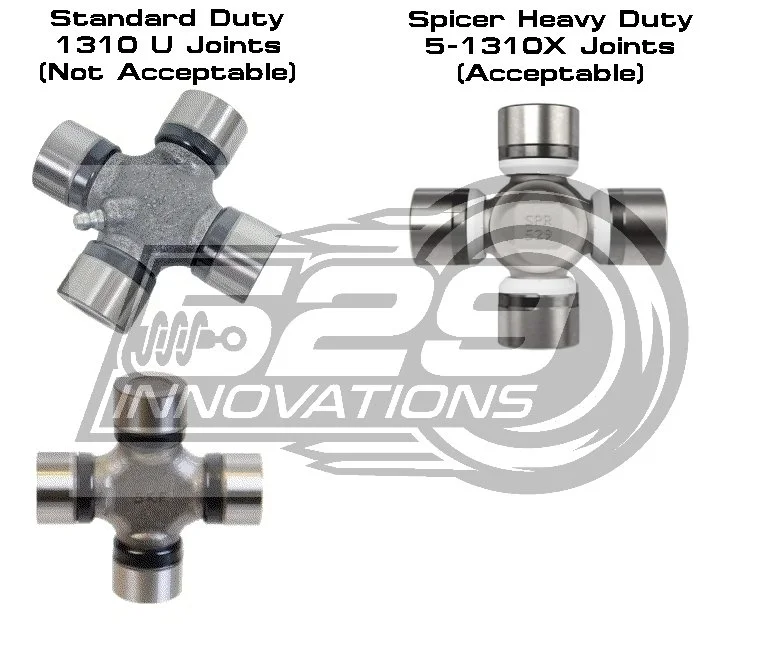
U Joints are commenly referenced by a “series number” which defines the dimensional data of the u-joint. Two of the most common u-joints used in afternaret driveshafts are the 1310 and 1350 series with variations of each of those. They include greasable, non greasable, standard and heavy duty versions as well as variants used in both low and high speed applications. The first image below shows some common variations of a 1310 u-joint, similar variations are also available for the 1350 series u-joint. For all of our driveshafts we only use non greasable, Spicer Extreme duty “ X Series” u-joints as they have the highest torque capacity of any commercially avaible high speed u-joint.
RS3/TTRS specific torque limits
One of the most important considerations when selecting a u-joint is the torque capacity. On haldex based vehicles, the amount of torque that can be sent to the rear is limited. In a typical situation, the most torque that can be sent to the rear is 50% of the engine output. There are some situations where this can be exceeded but the 50% number is a good baseline.
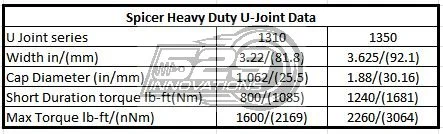
The table below lists the published dimensional data and torque limits of the Spicer 1310 and 1350 “X” series u-joints we use in our driveshafts. Regarding torque limits, there are two values to consider, the “Short Duration” and the “Max Torque” limit. The “Short Duration” limit is just that, what you see at launch and running down the track. The “Max Torque” value is when the u-joint will deform and eventually fail. From the onset, this has been how we have set expectations with our driveshafts and have shared details about managing torque especially in first and second gear and when using aftermarket clutches. The torque limit of the 1310 driveshaft correlates to our published limit of “up to 1200hp” . Going beyond that is simply an unrealistic expectation.
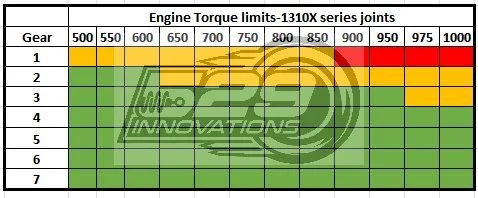
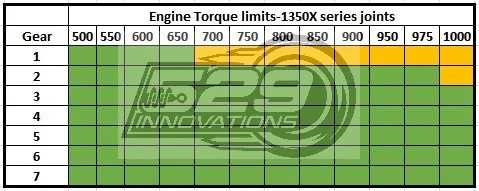
Using engine torque and the DQ500 gear ratios in the RS3/TTRS we were able to determine reasonable limits. The next two color coded tables are intended to provide guidance on torque limits of the 1310X and 1350X u-joints as used in our driveshafts. Situations such as wheel hop, overly aggressive haldex clutch engagement and other situations that shock the drivetrain will result in lowering these limits and will lead to premature failure of the u-joint. In addition, as the operating angle of the u-joint increases the torque capacity will decrease.
Green: below “Short Duration “ torque
Yellow: Operating above “ Short Duration torque” but not exceeding “Max Torque”
Red: Exceeding “Max Torque” limit